Newsroom
Surfer 2
Surfer 2 is a cross-platform computer-use agent that runs on desktop, web, and mobile, with state-of-the-art results on four agentic benchmarks.
October 17, 2025 · 4 min read

H Company is releasing Surfer 2, a computer-use agent with a single architecture built for practical use. Our aim is to move from models that know things to agents that do things: systems that act reliably in real digital environments.
Surfer 2 is a cross-platform computer-use agent that runs on desktop, web, and mobile. It beats the previous state of the art on four agentic benchmarks across those platforms, ahead of agents from labs like OpenAI, Anthropic, and Google.
Key highlights
- H achieves state-of-the-art results on four major agent benchmarks spanning desktop, web, and mobile environments (OSWorld, WebVoyager, WebArena, AndroidWorld), surpassing human performance on desktop and mobile environments.
- Surfer 2 combines third-party frontier models and Holo1.5 models in one architecture, which shows how far careful agent design and targeted model training can push performance.
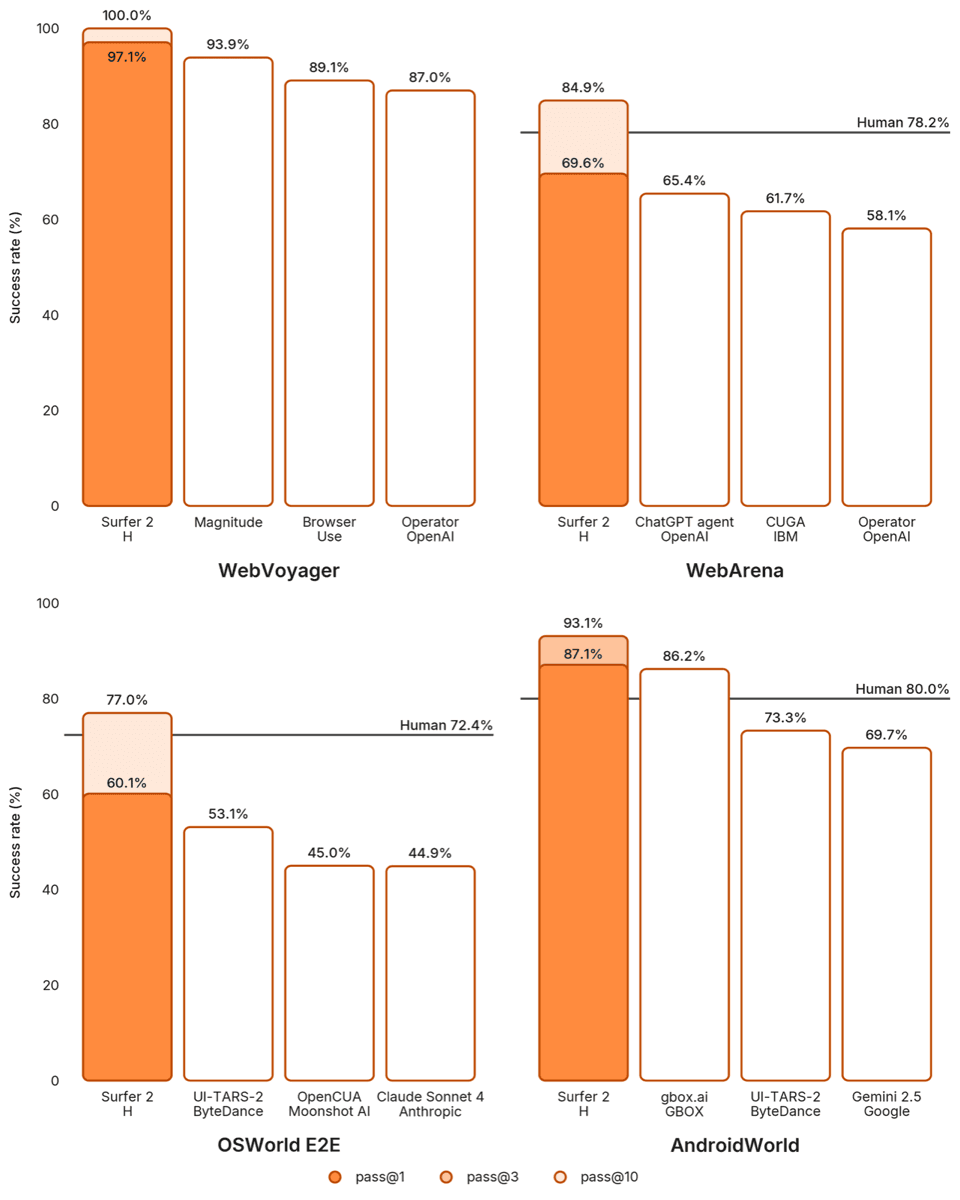
Surfer 2 achieves leading success rates across web, desktop, and mobile benchmarks.
Surfer 2: A unified architecture
Our original web browsing agent, Surfer-H, delivered Pareto-optimal performance on web browsing tasks (from WebVoyager). In just four months, we built on what we learned to achieve state-of-the-art results across platforms with Surfer 2.
Surfer 2 is an agent architecture for computer use. It separates strategic planning from tactical execution, with an orchestrator module managing planning and coordination while sub-agents act across interfaces.
Surfer 2 can be configured with or without the orchestrator module. When enabled, the orchestrator decomposes the primary goal into a set of sub-tasks assigned to sub-agents. Upon completion, each sub-agent reports its outcome and intermediate state back to the orchestrator. Based on these reports, the orchestrator determines its own next step: either producing a final output, advancing to the next sub-task, or replanning in the event of failure.
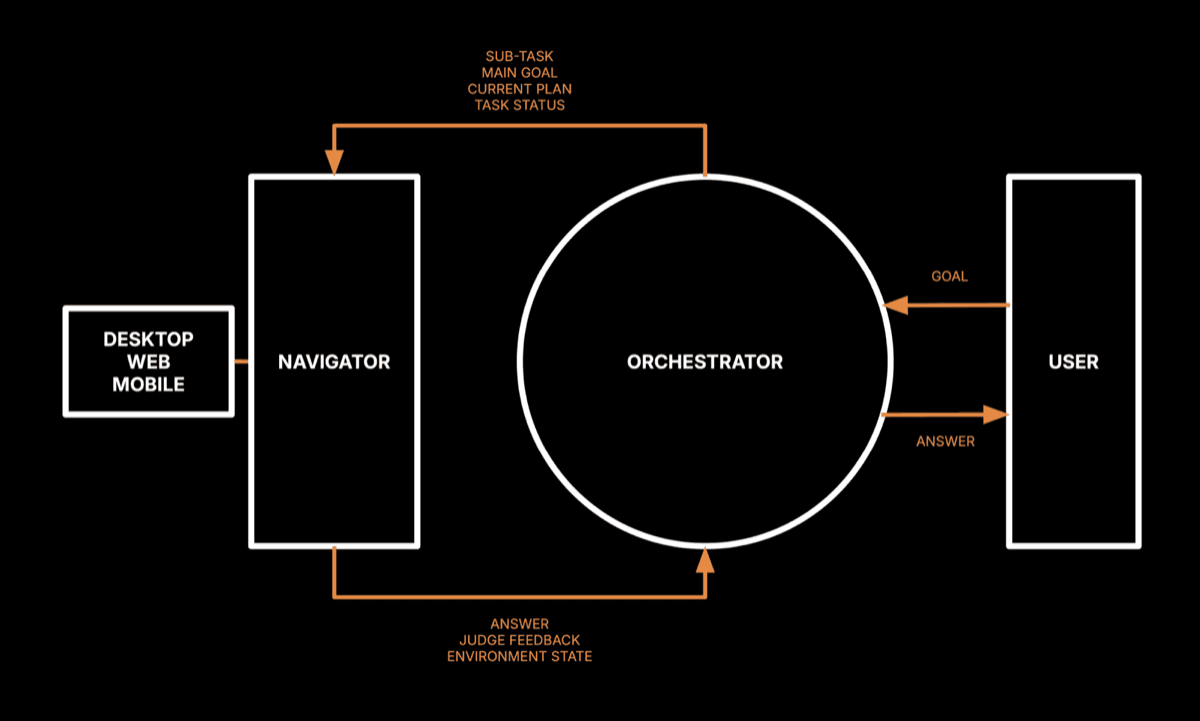
Surfer 2 follows a ReAct (reason+act) loop. At each step, it assesses its progress towards its task, and determines its next action. Reliable performance across environments relies on dedicated components for visual grounding (see more below), task validation, and failure recovery, along with an integration layer that turns its actions into accurate system control. Because an agent is only as capable as the actions it can reliably perform, these layers are central to Surfer 2's consistency.
The result is an agent that keeps improving as frontier models improve and gets the most out of each one.
SOTA performance across desktop, mobile & web
Desktop
OSWorld evaluates an agent's ability to control a full desktop environment on Ubuntu systems across diverse applications via human-like interaction. In the Foundation E2E GUI category where only visual perception and interaction are allowed, Surfer 2 achieves state-of-the-art with pass@1 of 60.1%. Our system reaches 77.0% with pass@10, surpassing the human baseline score of 72.4%.
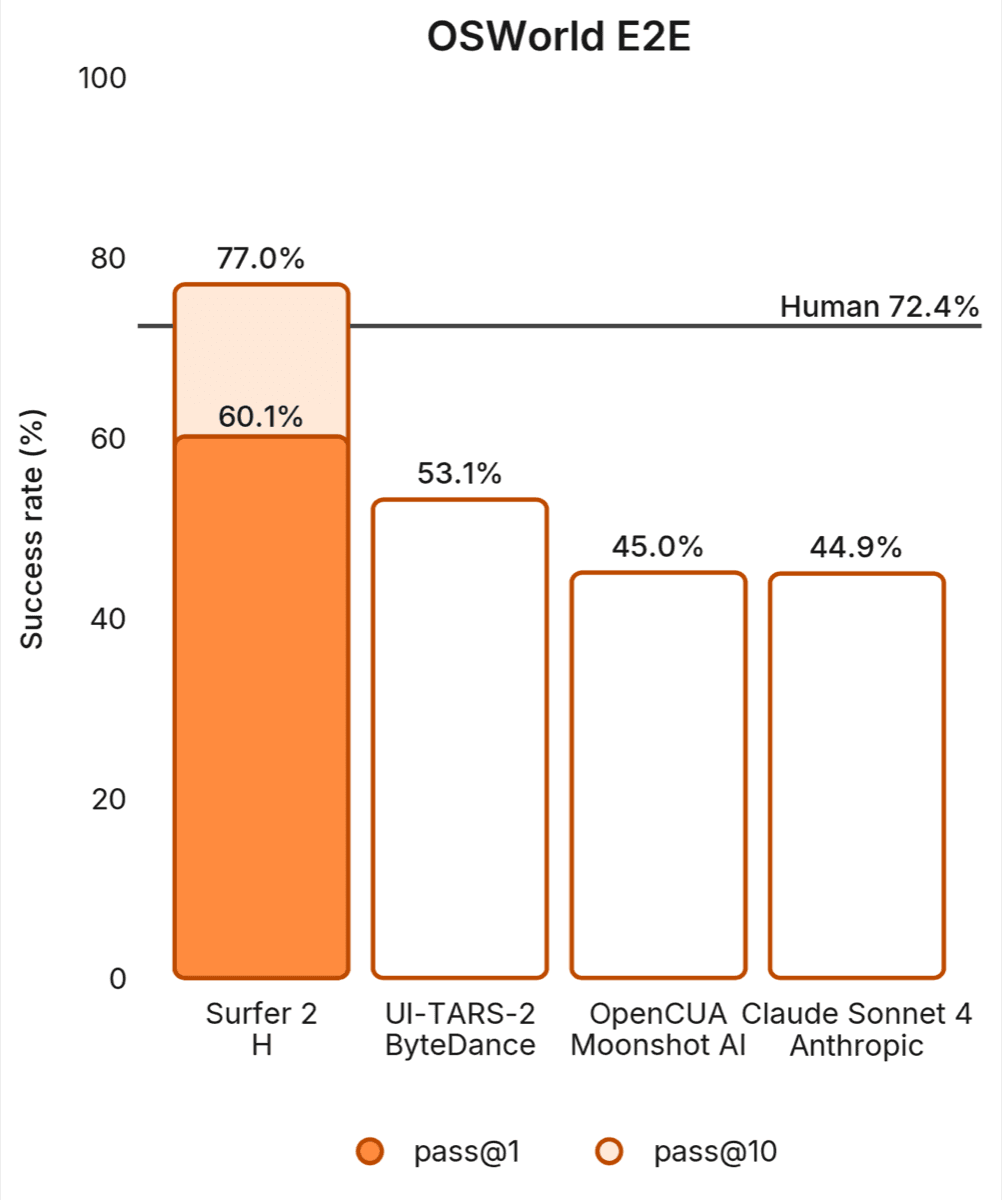
Surfer 2 reaches 60.1% pass@1 and 77.0% pass@10 on OSWorld E2E.
Web
WebArena evaluates agents in a sandboxed web environment from five categories (E-commerce, social forum, collaborative development, maps, CMS platforms) with functionality and data mimicking their real-world equivalents. Surfer 2 achieves a state-of-the-art score of 69.6% by decoupling planning and execution.
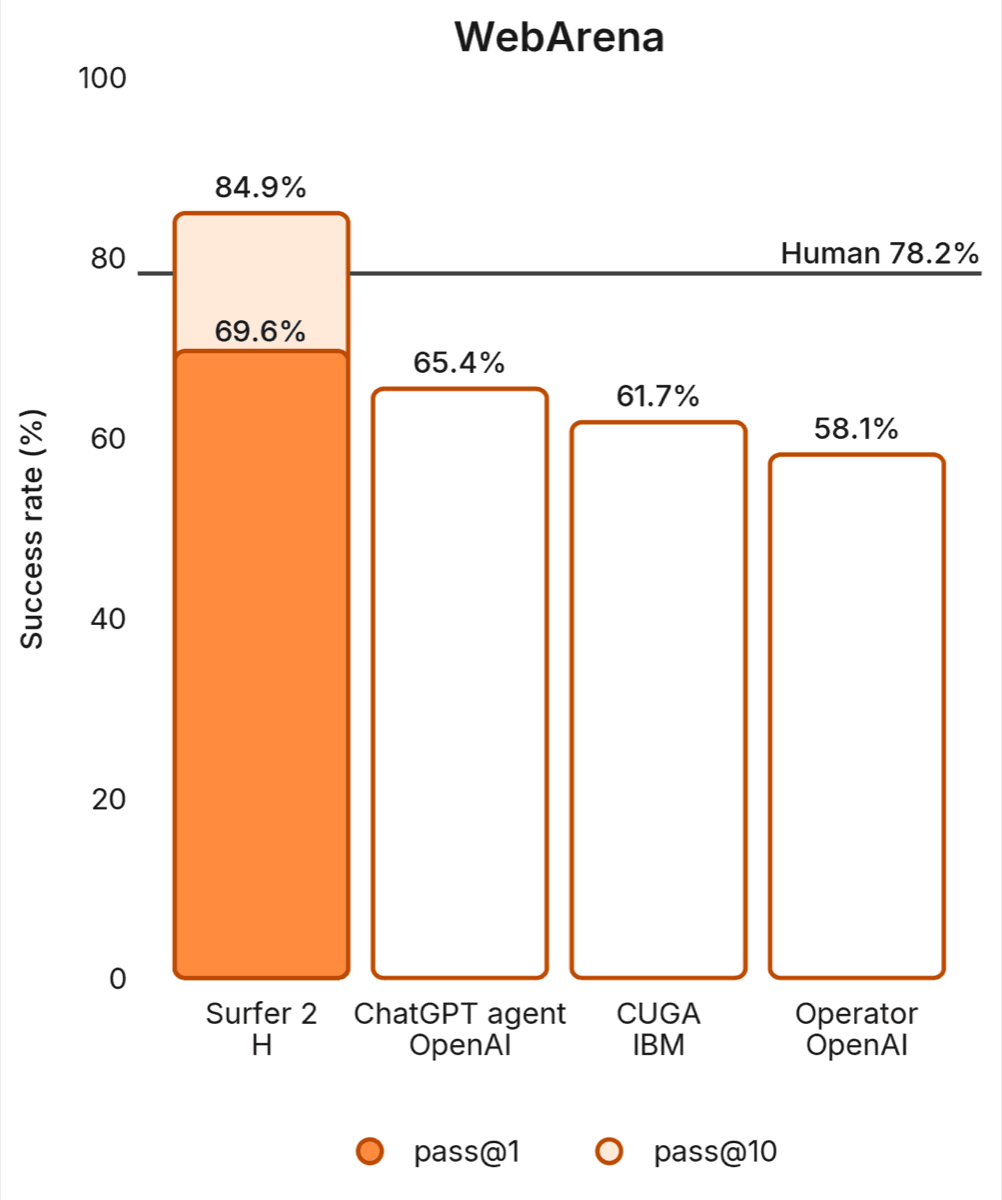
Surfer 2 achieves 69.6% pass@1 and 84.9% pass@10 on WebArena.
WebVoyager assesses web information retrieval on dynamic live websites. On this benchmark Surfer 2 reaches a success rate of 97.1%, surpassing Magnitude's previous state-of-the-art of 93.9%.
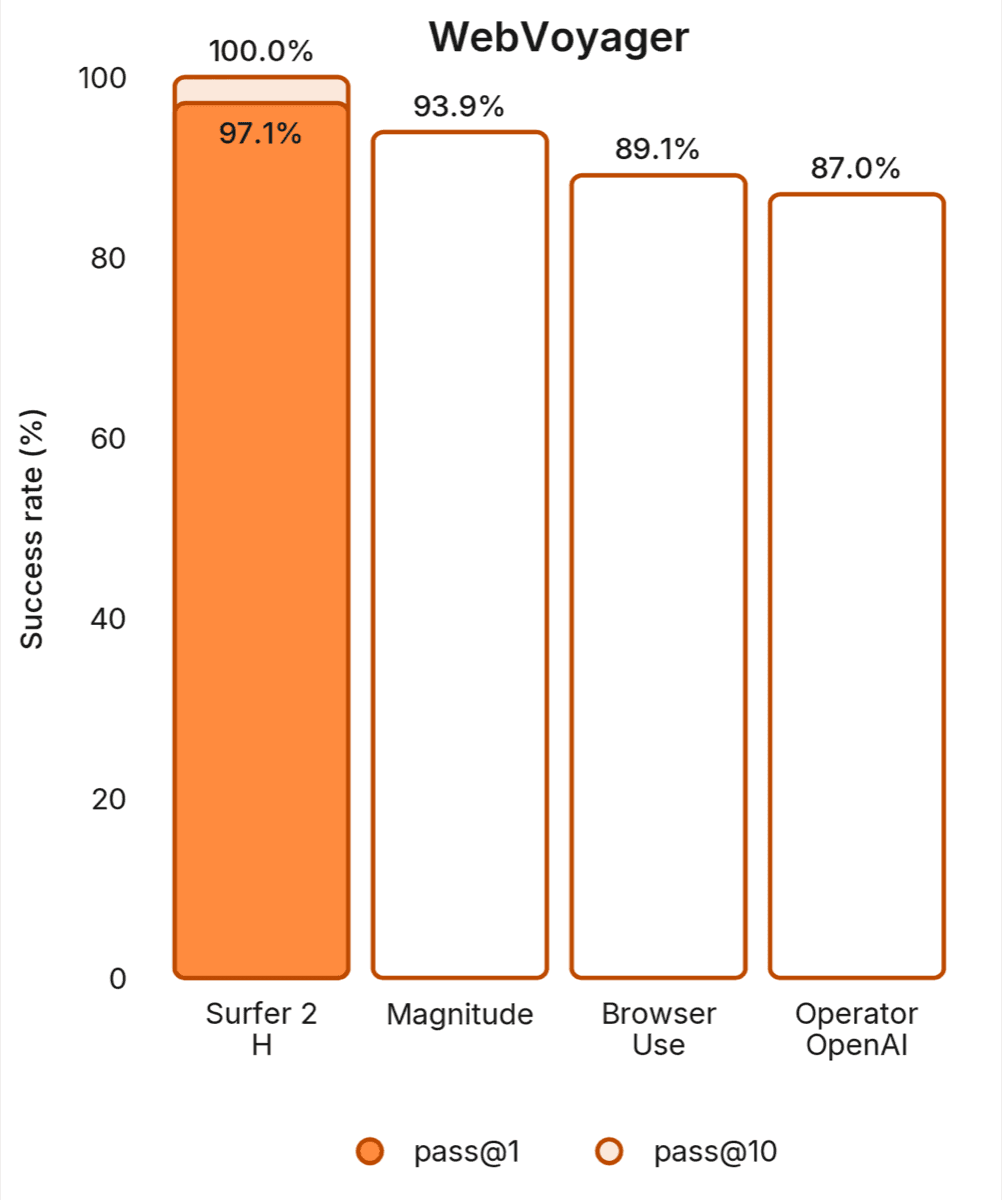
Surfer 2 reaches a 97.1% success rate on WebVoyager.
Mobile
AndroidWorld evaluates an agent's capability to control an Android device and use 20 real applications. On this suite, Surfer 2 achieves a success rate of 87.1%, reaching state-of-the-art level in the visual interaction category. Relying on vision and human-like interaction (swipe, press, type) allows Surfer 2 to be proficient across applications and Android versions, surpassing the human baseline of 80.0%.
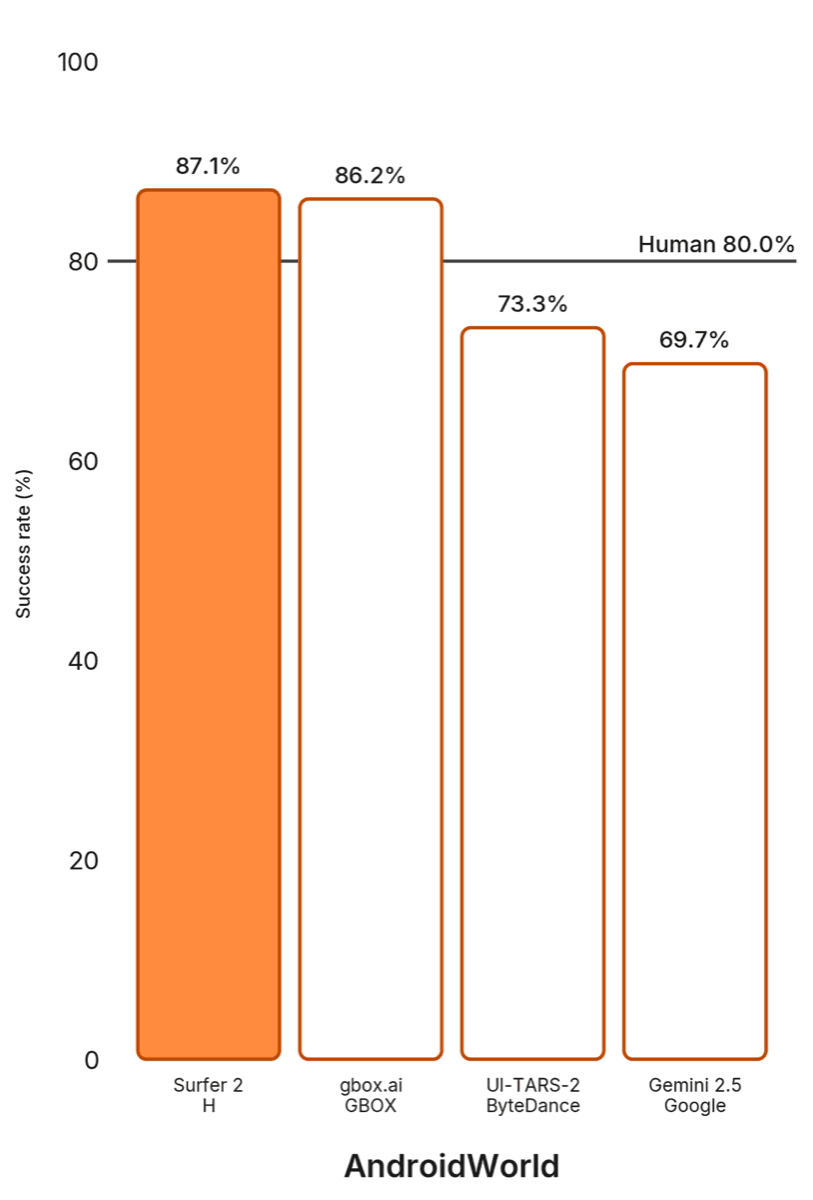
Surfer 2 achieves an 87.1% success rate on AndroidWorld.
What's next?
Surfer 2 is about the best you can currently do with a mix of third-party and internal foundation models. Pairing our own agent training and infrastructure with the strongest external models gets us state-of-the-art results across desktop, web, and mobile, often matching or beating people.
These results didn't come cheap: Surfer 2 runs are extremely costly. That's why we're now training Holo2, our next proprietary model, to hit the same performance at a fraction of the cost and make these agents cheap enough to run at scale.
In the past few months we've open-sourced Surfer-H, launched Holo1.5, and set new records on desktop, web, and mobile with Surfer 2. There's plenty more to do, and we'll keep pushing on capability, reliability, and cost.
See our Surfer-H agent in action and start using it to find information and solve real-world problems, today.
Or, check out our full technical report detailing Surfer 2's performance, state-of-the-art benchmark results, and cross-platform evaluations!