Newsroom
Holo3: Breaking the Computer Use Frontier
Holo3 sets a new state of the art on OSWorld-Verified, at a fraction of the cost of large proprietary models.
March 31, 2026 · 3 min read
Today we're releasing Holo3, the next model in our work on autonomous enterprise agents. Holo3-122B-A10B scores 78.85% on OSWorld-Verified, a new state of the art on the main desktop computer-use benchmark.
Holo3 isn't just a benchmark leader; we built it for production. Using our agentic flywheel, we trained it to run real workflows inside synthetic enterprise environments. That makes it good at today's business tasks and sets it up to handle a much wider range of software over time.
Best of all, Holo3 achieves this with only 10B active parameters (122B total), so at a fraction of the cost of large-scale proprietary models, such as GPT 5.4 or Opus 4.6. All models are available through our Inference API. Holo3-35B-A3B weights are openly accessible on Hugging Face under the Apache2 license and freely accessible through our inference API under a free tier.
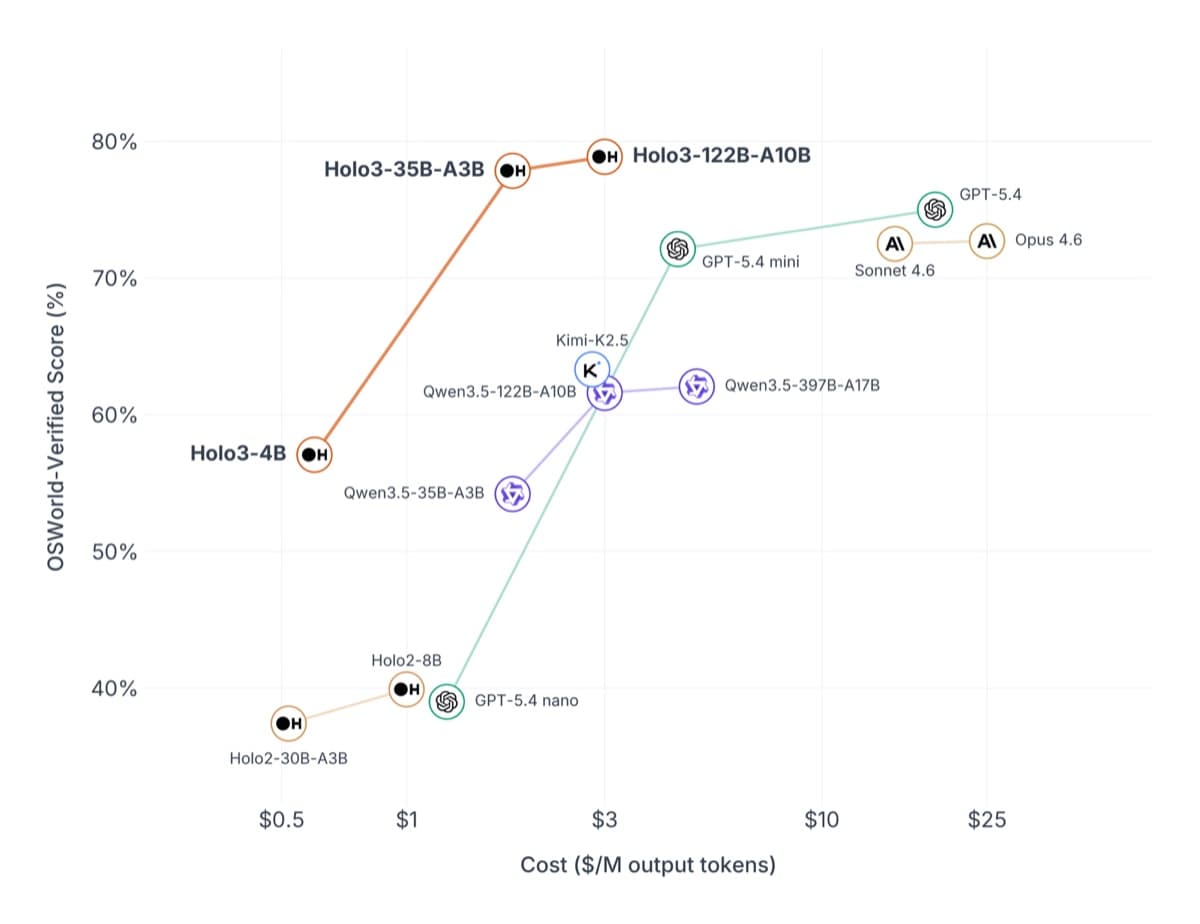
OSWorld-Verified score versus cost per million output tokens for Holo3, Holo2, Qwen3.5, Kimi-K2.5, GPT-5.4, and Claude 4.6 models.
The Agentic Learning Flywheel
Holo3's edge comes from its training pipeline, a feedback loop that sharpens the two things an agent needs most: perception and decision-making.
The flywheel teaches the model to carry out specific tasks from annotated examples while building general skills across a huge range of interfaces. Here's how we build these computer-use models:
- Synthetic Navigation Data: using human and generated instructions, we generate scenario-specific navigation examples.
- Out-of-Domain Augmentation: we programmatically extend the scenarios and augment the data to ensure Holo3 can handle the unexpected.
- Curated reinforcement learning: every sample is filtered and run through a reinforcement-learning pipeline tuned for performance.
Beyond the scores, the OSWorld results are proof that the flywheel works. To check that it transfers to real business applications, we built the Synthetic Environment Factory.
The Synthetic Environment Factory & H Corporate Benchmarks
This factory reproduces the reality of enterprise systems and is one of the environments we trained Holo3 in. Coding agents build the environments automatically, programming websites from scratch based on scenario specifications, and produce verifiable tasks of varying difficulty that are validated end-to-end with verification scripts.
To measure real-world readiness, we also designed H Corporate Benchmarks, a dedicated evaluation suite of 486 multi-step realistic tasks spanning 4 categories: E-commerce, Business software, Collaboration, and various Multi-App setups.
The benchmark spans the full complexity spectrum: from focused, single-application tasks to long-horizon, multi-application workflows that mirror how work actually gets done. At the harder end of the scale (Multi-Apps), tasks require the agent to coordinate information across multiple systems simultaneously. For example, retrieving equipment prices from a PDF, cross-referencing them against each employee's remaining budget, and autonomously sending personalised approval or rejection emails to every individual. This kind of task demands not only accurate calculation and document parsing, but sustained multi-step reasoning across applications without losing state or intent.
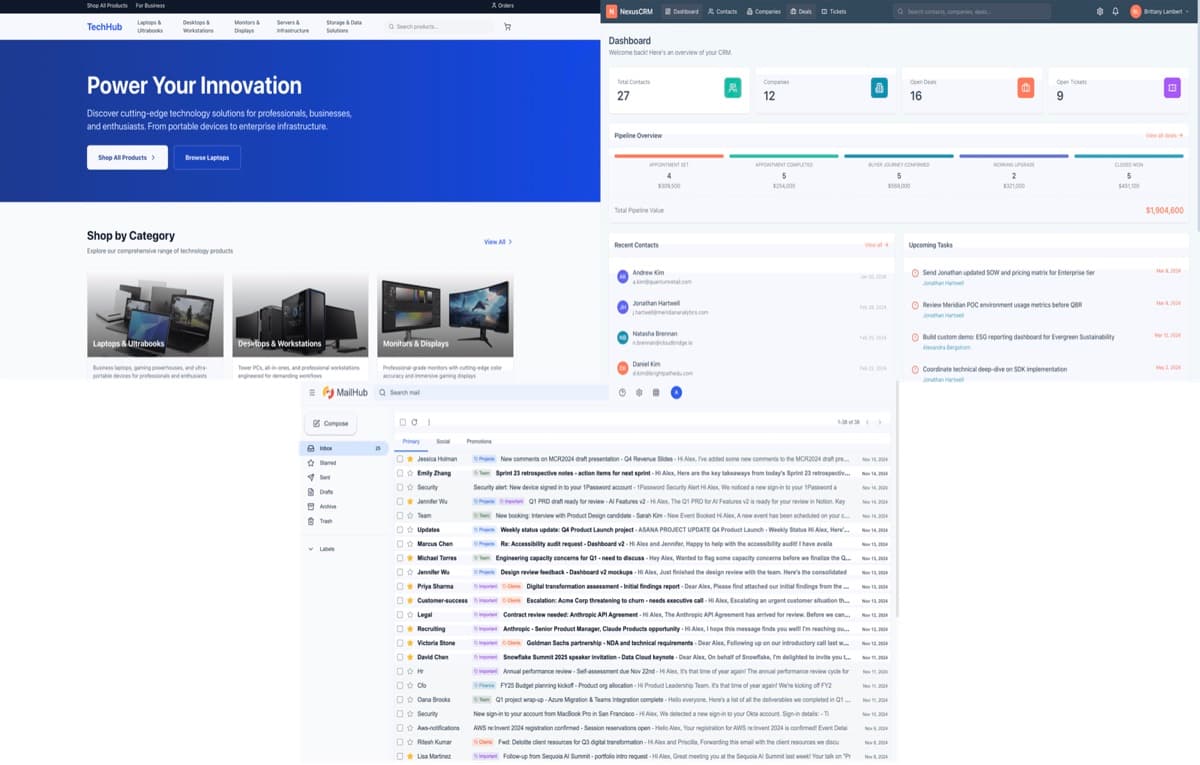
Examples of synthetic environments created for training Holo3.
The results below show Holo3 ahead of its competitors on single-application benchmarks. The gap between Holo3 and the base Qwen3.5 models is what the flywheel buys us: higher success rates than models with far more parameters, at the same localization and grounding quality.
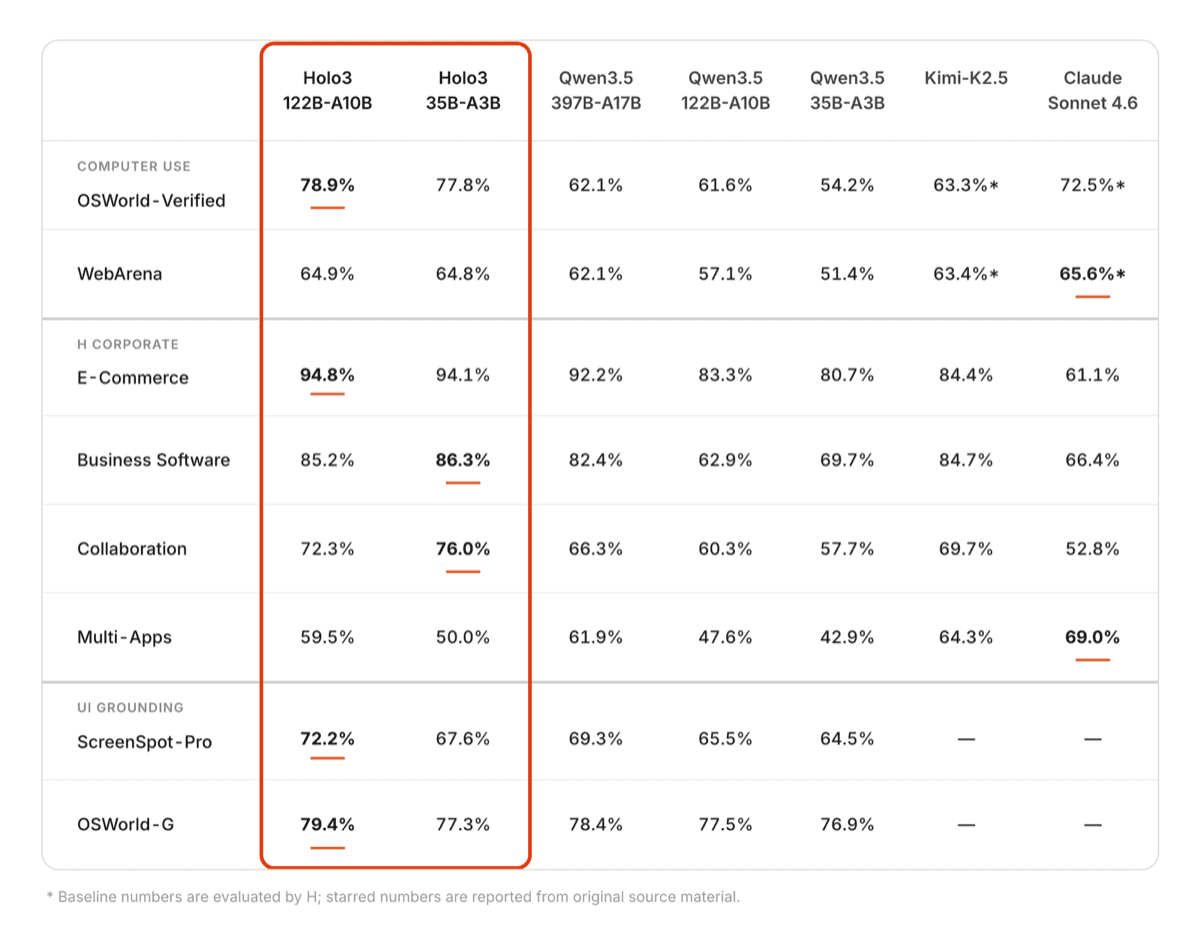
Holo3 leads most computer use, H Corporate, and UI grounding benchmarks. Baseline numbers are evaluated by H; starred numbers are reported from original source material.
Towards Universal Agency
Holo3 is a milestone, not the finish line. By building a system that can see, reason, and act inside our clients' software, we're making the autonomous enterprise real.
As the Synthetic Environment Factory keeps growing, our agents take on harder tasks. Holo3 handles known interfaces well; we're now working on the next step, adaptive agency, where a model can learn to operate new, custom enterprise software on its own, in real time.