Newsroom
Meet the winners of the H x 42AI hackathon in Paris
More than 80 builders spent two days in Paris building agents that use a computer the way a person does. Here are the three winning teams, how they built their projects, and a few ideas to help you build your own.
November 25, 2026 · 5 min read
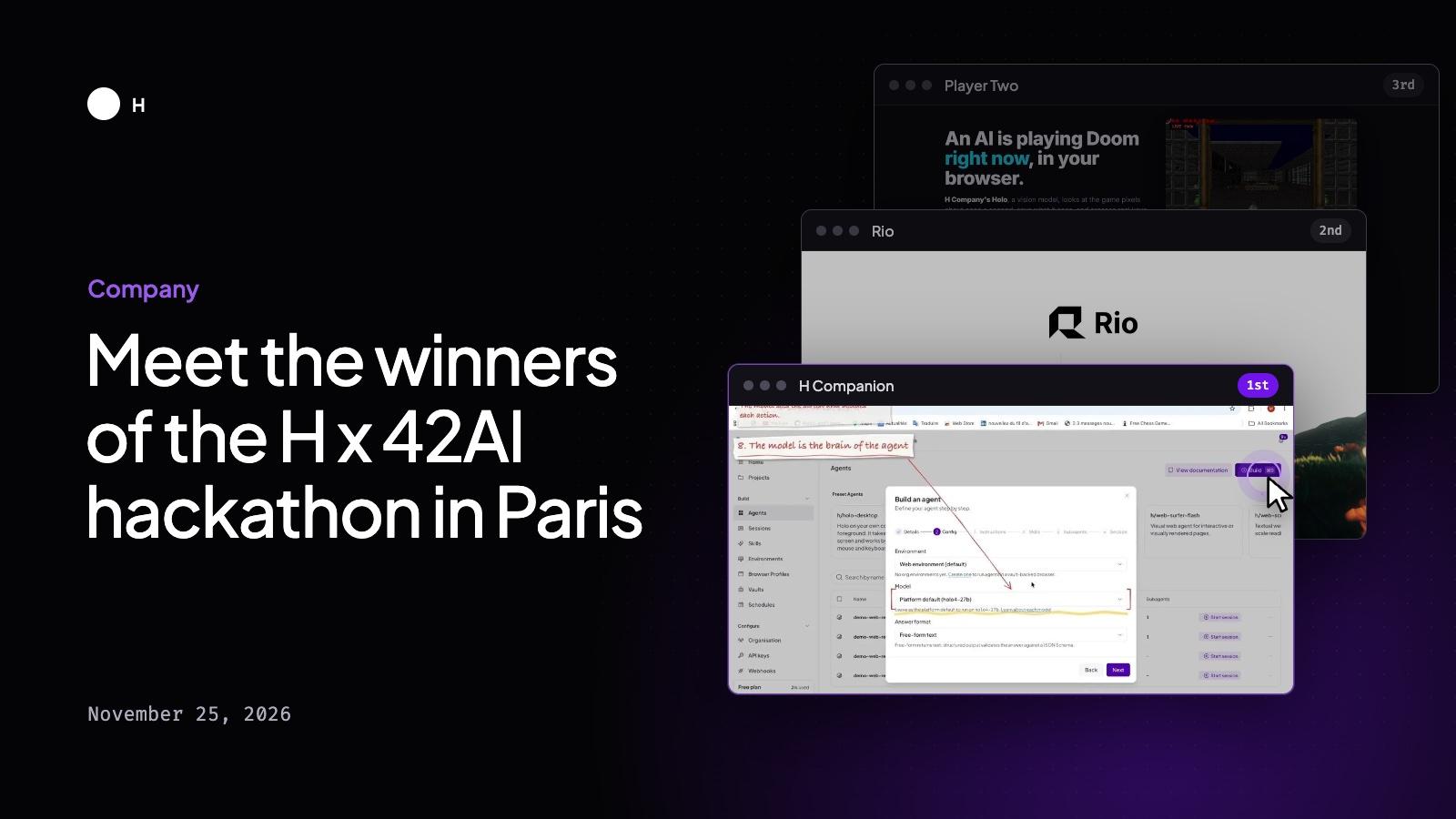
On 7 and 8 November, more than 80 builders spent two days in Paris building agents that use a computer the way a person does: they look at the screen, then click, type and move on to the next step. The hackathon was co-organized with 42AI, and every team built with H's computer-use agents and Holo models.
By Sunday afternoon the jury had 34 projects to review. Some automated desktop software that has no API at all. Others guided people through an app in real time, played video games to find bugs, or tested whether a website works for someone with low vision. Here are the three winning teams, how they built their projects, and a few ideas to help you build your own.
1st place: H Companion
A voice copilot that lives inside any software on your computer.
Ask H Companion how to do something and it points at the right button. If you get stuck, it helps you through the next step, and if you'd rather not do it yourself, it does the task for you.
How they used H: the team combined both APIs. The Agents API runs the agent on the user's own Mac, while the Models API handles grounding: Holo reads screenshots cropped around where the user is looking and finds the exact element on screen. A separate read-only session then checks that the task actually succeeded before the agent reports back.
Team: Edouard Foussier, Matteo Atkinson, Tom Angles
See H Companion on the Showcase →
2nd place: Rio
Turns any tutorial into live guidance on your screen.
A ghost cursor shows you where to click in the app you're using, one step at a time. When you'd rather watch than do, Rio can complete the whole task for you.
How they used H: the team wrote their own loop in Rust on top of the Models API, using Holo for pointing and for autopilot, and used the Agents API for web research. Showing someone where to click inside an arbitrary desktop app takes a model that understands the live screen, and that's the part Holo handles.
Team: Jacques Dumora, Talal Aamir, Wassim Badraoui
3rd place: Player Two
A QA tester that plays Doom from pixels.
Player Two plays the game the way a human tester would, with no access to its internal state. When it hits a bug, Devin writes the fix. The project also took home the Cognition prize.
How they used H: the desktop version runs as an Agents API agent, and a browser version uses the team's own loop on the Models API. Testing from the screen alone works for any game or app you can't hook into, which is most of them.
Team: Dmitry Bogomolov
See Player Two on the Showcase →
Explore all the projects
The weekend covered a wide range of use cases: from Senna Systems, a copilot for rail control centres that operates legacy tools under the operator's approval (and winner of the Gladia prize), to Humble, which tests whether a website works for people with low vision, a tremor or colour blindness by browsing it the way they would, and many more.
Most of the projects from the weekend, including all eight finalists, are on the H Showcase with their demo. You'll also find projects from our previous hackathons and from the community there. Feel free to submit your own.
What teams built with computer use
The projects covered a wide range of use cases. Here are the four topics that came up most often:
- Software with no API. Many teams went after desktop and legacy tools: school management software, back-office systems, operational consoles. When there's no API to call, an agent that works through the interface is often the only way in.
- Guidance on your own screen. Two of the three winners used computer use to teach rather than replace the user, pointing at the right place in an app so people learn by doing.
- Accessibility and public services. Teams built voice assistants for blind users, helpers for administrative forms, and a tester that experiences a website the way a user with low vision or a tremor would.
- Testing from the screen. From plain-language test runs across operating systems to black-box game testing, several teams treated computer use as a way to test software the way people actually use it.
Tips for building your own
The quickest way to get started with the Agents API is our quickstart: one call starts an agent in a cloud browser or on your own desktop, and you can watch it live and redirect it mid-run. Start from a pre-built agent, then create your own when you need more control.
If your agent handles anything sensitive, look at custom tools. They let the agent call your own code in the middle of a task, for example to ask the user to confirm before paying, look up an order, or hand off to a human. A few teams discovered them during the weekend, and they're one of the simplest ways to build an agent people can trust.
Start building
Every project above runs on the same tools you can use today.
- Create your account and get your API key on the H platform
- Run your first agent in a few minutes with the Agents API quickstart
- Get inspired by every project from the weekend on the H Showcase
- Get technical help from our team and other builders on Discord
See H Company agents running on your systems.
We map one of your workflows with you, then show agents working on it. We respond within 24 hours.